
You went down to swap the laundry and your sock got wet on the concrete. Now you are googling foundation repair companies and the quotes you are finding start at numbers that make you sit down. Before you sign anything, spend ten minutes outside with a garden hose. A huge percentage of wet basements in Minnesota, North Dakota, and Eastern Washington are caused by gutters and grade, not failing foundations. Fixing the roof water is a fraction of the cost and often ends the problem entirely.
First Question: Is It Correlated With Rain?
Walk downstairs the next time it has been dry for a week. Dry? Good. Now walk down during the first hour of a steady rain. If water shows up within an hour or two of rain starting, or during spring melt, this is almost certainly surface water, which means it came in from above. That is gutter and grade territory.
If the floor is wet regardless of weather, you may have a genuine groundwater or plumbing issue and you should call someone. But most of the calls we take in April in Grand Forks and in March in Spokane Valley are the first kind.
The 6 to 10 Foot Rule
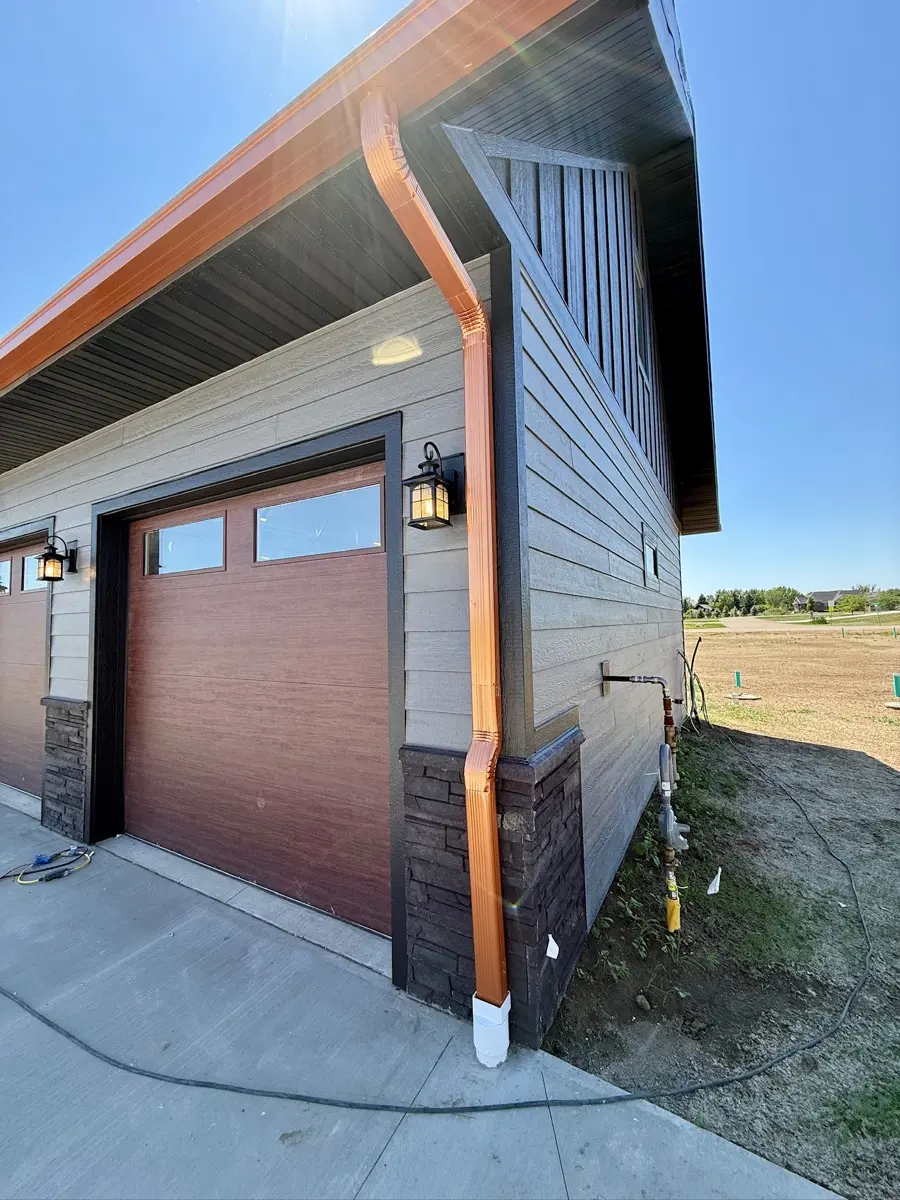
Walk every downspout on your house. Where does the water go when it leaves the gutter? If it splashes onto a concrete pad right against the foundation, or dumps into a short black corrugated pipe that ends three feet from the house, you found the problem.
Rule of thumb that works: downspout discharge should be at least 6 feet from the foundation, 10 is better, and the ground should slope away the whole distance. On a typical two-story house with 1,500 square feet of roof, one downspout moves thousands of gallons during a single thunderstorm. Dumping that load next to a basement wall is guaranteed to find a way in through the cold joint or a hairline crack.
The fix can be as simple as a 6-foot aluminum downspout extension or a buried drain line that runs out to daylight in the yard. If the lot is tight, a pop-up emitter at the edge of the flower bed solves it. We go deeper on this in our post on why downspout extensions are essential for your home.
Check the Grade
Stand at each corner of the house and look at the ground. Does it slope away or toward the house? You want a fall of at least 6 inches over the first 10 feet away from the foundation. A lot of older Bismarck and St. Paul houses have settled, and the soil has packed down around the foundation to the point that water now runs toward the wall. Regrading with clean fill is cheap and it works.
While you are down there, look at the flower beds. Mulch piled up against the siding is a classic way to trap water and rot the sill plate. Pull it back six inches.
The Clogged or Undersized Gutter Problem
A clogged gutter overflows in exactly the wrong place, which is usually right over the corner where your basement leaks. All the water from the upper half of the roof pours off in a concentrated curtain, hits the ground at one spot, and soaks straight down to the footing.
Undersized gutters do the same thing more subtly. A 5-inch gutter with a single 2x3 downspout cannot keep up with the runoff from 800 square feet of steep roof during a real downpour. It fills, then sheets over the front edge. From the ground it looks like the gutter is “fine, it just overflows when it rains hard.” That is not fine. That is concentrated loading at the foundation every time it rains hard, which in the Red River Valley is a lot. If this sounds familiar, we break down all five common causes in why your gutters are overflowing even though you just cleaned them.
The Garden Hose Test
Here is a test you can run yourself in about fifteen minutes. You need a helper and a garden hose.
Have your helper go to the basement with a flashlight and stand near wherever the water has been showing up. Go up on a stepladder (or a roof if you are comfortable) and run the hose into the gutter on that side of the house, full blast, starting at the end farthest from the downspout. Run it for five minutes.
Three things can happen.
One, your helper sees water come in. You now know the problem is roof water reaching the foundation on that side. Gutter, downspout, grade, or all three.
Two, the gutter overflows before the water even reaches the downspout. Downspout is clogged or gutter is pitched wrong. Fix it.
Three, the water runs through the gutter, down the downspout, and out the extension, and your helper stays dry. Repeat on the next side of the house. If no side of the house causes a leak, then yes, you probably do have a groundwater issue and a waterproofing contractor is the right call.
When Gutters Alone Solve It
In snowmelt season, well over half of the wet-basement calls we take in MN and ND end up being a gutter, downspout, or grading problem. The fix is gutter work, not excavation, and the difference in cost between the two is enormous. It is worth ruling out before you sign a waterproofing contract. Downspout installation and replacement is one of the most common jobs we run.
If you want a second opinion before you commit to digging up your yard, we will come look for free. North Dakota (701) 580-9991, Minnesota (763) 292-4044, Idaho and Eastern Washington (208) 675-9991.