
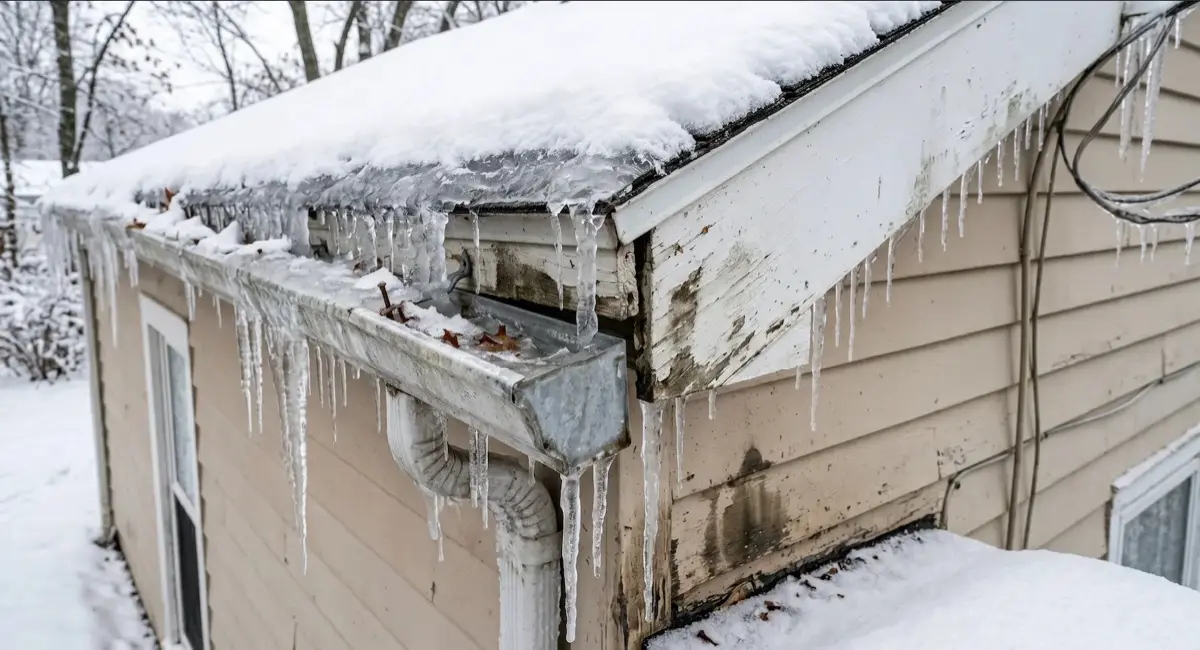
Every February we get the same call from somewhere in Wright County. There is a ridge of ice sitting on the gutter, icicles hanging to the deck rail, and a water stain spreading across the ceiling of the front bedroom. Somewhere in the conversation, the homeowner asks: would gutter guards have stopped this?
The honest answer is no, not by themselves. But the full answer is more useful than that, because the right guard system does change how your gutters survive a Minnesota winter, and the wrong one makes February worse. Here is how the whole thing actually works.
How an Ice Dam Forms
An ice dam is not a gutter problem. It is an attic problem that shows up at the gutter.
Warm air from your living space leaks into the attic through can lights, bath fans, the attic hatch, and every unsealed gap in the ceiling. That warm air heats the roof deck from below. The snow sitting on the upper part of the roof melts, even when it is well below freezing outside. The meltwater runs down under the snowpack until it reaches the eave, the part of the roof that overhangs the wall and sits outside the heated envelope of the house. The eave is cold, so the water refreezes right there at the roof edge.
Repeat that cycle for a few weeks and you get a dam of solid ice across the eave. Meltwater coming down the roof hits the dam, pools behind it, and starts working its way up under the shingles. Shingles shed water running downhill. They do nothing against water sitting in a pool. That is when the ceiling stain shows up.
We covered the destruction side of this in why your gutters ripped off the house this winter. The short version: the ice load that builds during a dam cycle is far beyond what any gutter was designed to carry, and when the ice sheet shifts, it takes the gutter with it.
What Gutter Guards Actually Do in Winter
Here is the part that gets oversold by national guard companies, so let us be precise.
Gutter guards do not prevent ice dams. The dam forms on the roof edge above the gutter, driven by heat loss from the attic. No product that sits in or on your gutter changes the physics on the roof deck. Any salesperson who tells you a guard will stop ice dams is selling you something that will not do what they said.
What a good guard system does do is keep the trough itself clear going into winter. That matters more than it sounds. A gutter that enters November full of oak leaves and maple keys freezes into a solid debris-and-ice brick at the first hard freeze. Once that happens, the gutter contributes to the problem: meltwater that reaches the eave has nowhere to go, so it pools, refreezes, and feeds the dam faster. A clear trough gives midwinter melt, and especially spring melt, an actual exit path. On the thaw days when the dam is releasing water, a clear gutter drains it away from the foundation instead of letting it sheet over the edge and refreeze on your sidewalk.
So the fair summary is: guards keep the gutter doing its job through winter. They do not touch the root cause on the roof.
Why the Hanger Underneath Matters More Than the Screen on Top
Most homeowners comparing gutter guards look at the top surface: mesh size, hole pattern, how it handles needles and leaves. In Minnesota, the more important question is what is holding the gutter to the house when it is full of ice.
This is why we install the Alu‑Rex T‑Rex system on winter-country homes. T‑Rex is not a screen laid over the gutter. It is a continuous hanger: one structural aluminum rail that runs the full length of the gutter, fastened to the fascia along its entire run, with the guard surface built into it. Compare that to a conventional gutter hung on clips spaced every couple of feet. Every one of those clips is a single point taking the load of the ice above it, and every freeze-thaw cycle works the fasteners a little looser.
A continuous hanger spreads snow and ice load across the whole run instead of concentrating it at scattered points. That is the difference between a gutter that shrugs off a hard winter and one that peels off the fascia during the March thaw. It is also why T‑Rex carries a lifetime structural warranty alongside its 25-year clog-free warranty. Those are the manufacturer’s terms, and in our climate the structural half is the one that earns its keep.
The Real Fix Lives in the Attic
We install gutters and guards for a living, so believe us when we say this: the fix for ice dams is insulation and ventilation, and no gutter company product replaces it.
The goal is a cold roof. If the roof deck stays at outdoor temperature, the snow on it does not melt from below, and the dam never forms. Getting there means air-sealing the ceiling plane (top plates, light fixtures, bath fan housings, the attic hatch), bringing insulation up to current code depth, and making sure air can actually travel from the soffit vents to the ridge. Many older Minnesota homes are running half the insulation code calls for today, and a weekend of air sealing plus blown-in cellulose changes their winters completely.
Do that first, or at least alongside any gutter work. Then the guards and the continuous hanger are protecting a system that is no longer under siege every January.
What We Recommend for Minnesota Homes
If we are quoting your home in Cokato, Buffalo, Delano, or anywhere in the northwest metro, our winter checklist looks like this:
- Go into winter clean. A fall gutter cleaning matters more here than anywhere, because whatever is in the trough on freeze-up day is there until March.
- Guard the trough. Gutter guard installation keeps debris out so melt cycles can drain instead of stacking up.
- Hang it to survive. On new installs and replacements, that means the T‑Rex continuous hanger rather than clip-hung gutter.
- Fix the attic. We will tell you if your ice dam pattern points to heat loss, and that work comes before or alongside anything we sell.
When to Call
If you had ice dams last winter, the time to deal with them is now, in warm weather, not when there is a foot of snow on the roof and water on the windowsill. We will look at the gutters, the roofline, and the pattern of last year’s ice, and give you a straight answer about which parts are gutter problems and which parts are attic problems. In Minnesota, call (763) 292-4044 for a free estimate.